Pet Cameras & Monitors · 9 min
Can a Pet Camera Help with Dog Separation Anxiety? What Vets Say
Veterinary behaviorists weigh in on whether a pet camera helps with dog separation anxiety. Learn what features matter, what doesn't, and how to use cameras in a treatment plan.
Introduction
If your dog panics when you walk out the door, you have probably wondered whether a pet camera for dog separation anxiety is a legitimate tool or just an expensive way to watch your dog suffer in high definition. The short answer from veterinary behaviorists: cameras are not a treatment on their own, but they are one of the most valuable diagnostic and monitoring tools you can have during a structured behavior modification plan.
In this article, we break down what board-certified veterinary behaviorists and certified separation anxiety trainers actually say about camera use, which features genuinely help (and which can backfire), and how products like the Furbo 360° Dog Camera fit into an evidence-based approach. We also cover when to skip the gadget aisle and call a professional instead.
What Veterinary Behaviorists Say About Cameras and Separation Anxiety
The veterinary literature is remarkably consistent on one point: video monitoring is essential for diagnosing and treating separation anxiety. A 2025 article in *Today's Veterinary Practice* by Dr. Melissa Bain, a board-certified veterinary behaviorist, states that "it is imperative that the owner records a video of the dog when alone" because owner and neighbor observations alone can be misleading — a dog barking at the window may be reacting to squirrels, not experiencing panic. The Merck Veterinary Manual similarly notes that "videotaping or camera monitoring is generally the best way to diagnose behavior problems that occur when the owner is absent, as well as to assess the dog's response to treatment."
Certified separation anxiety trainers like Cathy Madson at Preventive Vet describe cameras as playing an "integral role" in treatment. The reason is practical: desensitization training requires you to keep your dog below its anxiety threshold, and the only way to know whether you have crossed that line is to watch what happens after you leave. Without a camera, you are guessing. With one, you have objective data to share with your vet or trainer. If you are just getting started with monitoring, our guide on how to set up a pet camera covers Wi-Fi requirements, placement, and training tips.
How Cameras Support Desensitization Training
The gold-standard treatment for separation anxiety is systematic desensitization and counterconditioning (DS/CC) — gradually increasing the duration of your absences while keeping your dog calm. According to the JAVMA, "the best way to evaluate behavioral changes is through review of a video recording, such that a baseline of behaviors can be identified and quantified." A camera lets you do exactly that in real time.
Here is how it works in practice: you leave for 30 seconds, watch the feed on your phone, and return before your dog shows signs of distress. Over weeks, you extend the duration. The camera tells you the precise moment your dog shifts from relaxed to anxious — lip licking, pacing, whining, door-fixation — so you can adjust the training pace. This is also why continuous viewing matters more than motion-triggered clips. A dog sitting still but panting and drooling is anxious, and a motion-only camera will miss that. If you are comparing options, our Furbo 360° vs. Furbo Mini 360° comparison breaks down which model offers the features that matter most for this kind of monitoring.
Two-Way Audio: When It Helps and When It Makes Things Worse
This is where marketing claims and behavioral science diverge sharply. Two-way audio is one of the most heavily promoted features on pet cameras, but veterinary behaviorists and certified trainers urge caution. The consensus is that for dogs with mild separation distress, hearing a familiar voice can function as a secondary reinforcer — but only if that voice has been previously conditioned to predict safety and reward through training. For dogs with moderate to severe separation anxiety, hearing the owner's voice without the owner physically appearing can trigger what behavioral scientists call frustrative non-reward: the dog hears you, expects reunion, and when you do not appear, arousal escalates.
A certified separation anxiety trainer (SAPro) writing on separation anxiety training notes that "there isn't any evidence that this is beneficial for a dog suffering from separation anxiety" and that some owners report their dogs become more distressed when they hear a voice but cannot find the person. The practical takeaway: test two-way audio while you are still at home. Watch your dog's reaction on the camera. If vocalization increases, pacing intensifies, or the dog runs to doors and windows, turn the feature off. The International Association of Animal Behavior Consultants emphasizes that any intervention should be evaluated by its effect on the individual animal, not by the owner's emotional comfort.
Furbo's Calm My Pet Feature: What It Actually Does
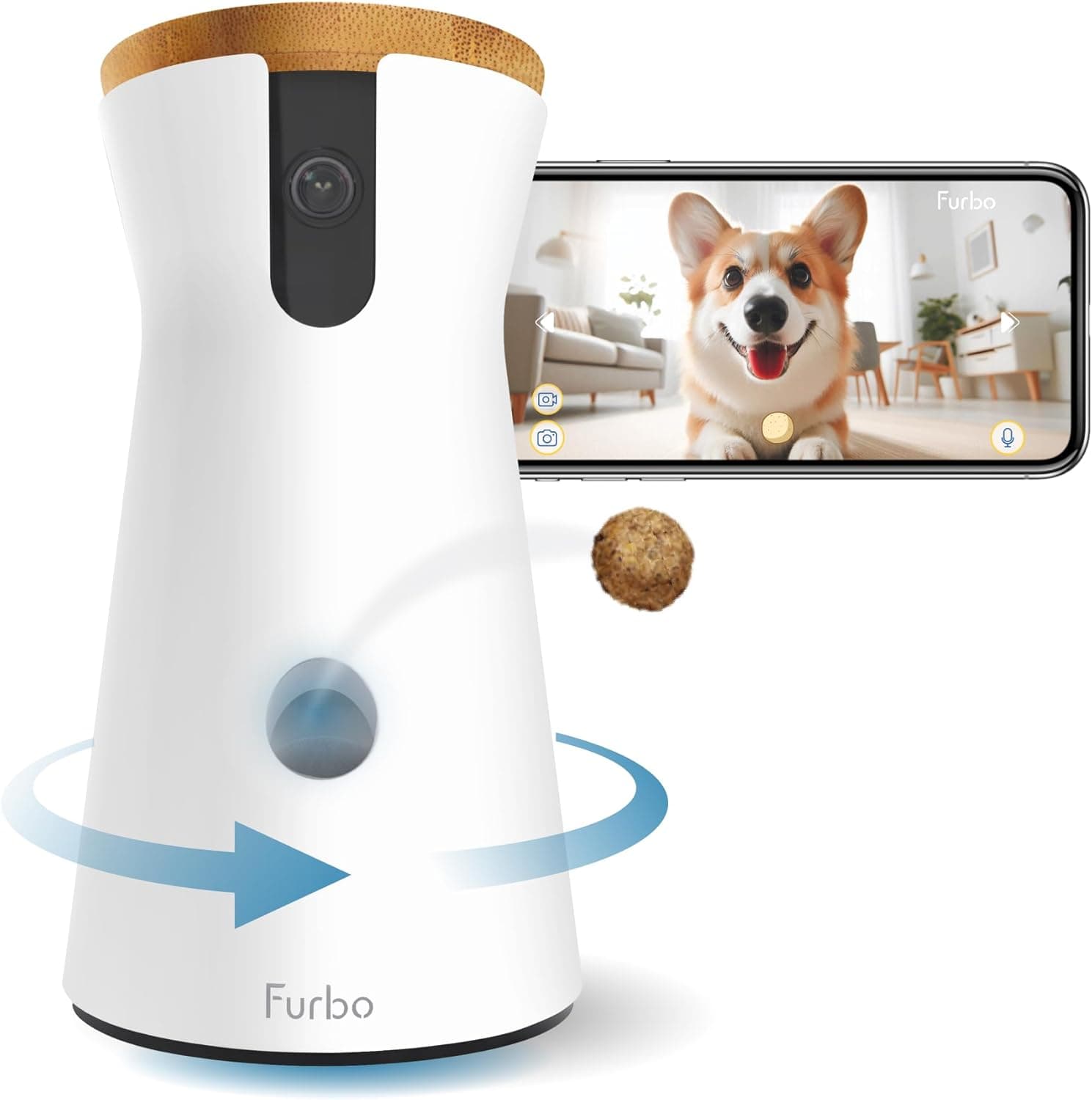
The Furbo 360° Dog Camera includes a Furbo Nanny feature called Calm My Pet that is specifically designed for anxiety-related barking. According to Furbo's help documentation, the feature activates when two barking events are detected within 15 seconds. It then plays soothing music for 30 seconds (repeatable up to six times), plays short distracting sounds like whistles or crinkling plastic (up to five times), and can toss a treat when barking stops. The entire event is recorded for later review.
Is this evidence-based? Partially. A peer-reviewed study published in *Applied Animal Behaviour Science* found that automated owner-voice feedback reduced separation-related vocalization by 95.7% in a sample of 40 dogs over two weeks. The mechanism — audio feedback triggered by vocalization — is similar in concept to Calm My Pet's bark-triggered response. However, that study used the owner's recorded voice, not generic soothing music, and it did not assess underlying emotional state, only vocalization duration. Calm My Pet's treat-on-quiet reward aligns with positive reinforcement principles, but it is not a substitute for a structured desensitization plan. Treat the feature as a useful supplement, not a standalone solution. You can explore the full Furbo 360° on our product review page or check it out on Amazon.
Building a Complete Separation Anxiety Plan With Camera Support
A camera is one tool in a larger toolkit. The five-step treatment framework outlined in *Today's Veterinary Practice* includes management (avoiding full absences during training), social communication and cues (relationship-building exercises), tools (food puzzles, pheromone diffusers, white noise), desensitization and counterconditioning, and medication when indicated. Your camera fits into steps one and four — it tells you when to return during desensitization sessions and provides the video evidence your vet or trainer needs to adjust the plan.
Practical setup tips: position the camera at chest level facing the door you exit through, since that is where most anxiety behaviors cluster. Ensure good lighting so subtle body language signals are visible. If your dog has access to multiple rooms, consider adding a second camera. For treat-dispensing cameras, use small, dry, round treats — our guide on the best treats for Furbo dog camera covers what works and what jams the mechanism. You can also browse more viral pet finds for complementary enrichment products that pair well with camera-based monitoring.
When to Skip the Camera and Call a Professional
If your dog causes self-injury during absences — broken nails, damaged teeth, skin wounds from escape attempts — or if distress behaviors persist beyond 30 minutes after departure with no improvement over two to three weeks of management, a camera will not solve the problem. These signs indicate moderate to severe separation anxiety that requires professional intervention. Seek a board-certified veterinary behaviorist (Dip ACVB), a certified applied animal behaviorist (CAAB), or an IAABC-certified consultant.
Your vet may recommend FDA-approved medications like fluoxetine (Reconcile) or clomipramine (Clomicalm) alongside behavior modification. According to the Merck Veterinary Manual, both medications are approved for canine separation anxiety and are most effective when combined with a behavior modification plan. Camera recordings remain valuable during professional treatment — they allow the behaviorist to observe your dog's natural behavior without the confounding presence of a stranger. For owners managing complex or senior dogs with multiple conditions, our Senior Pet In-Home Assistive Care Blueprint provides a structured framework for coordinating care at home.