PawProof PicksPet gear that earns trust

Subscription-Free Dog Health Tracking

FitBark 2: The Set-and-Forget Health Monitor Your Dog Won't Even Notice

At 10 grams with a battery that lasts up to six months, the FitBark 2 clips onto any collar and quietly tracks your dog's activity, sleep quality, and behavioral trends — all with zero monthly fees. It's not a GPS tracker, and it won't find a lost dog. But if you want objective, vet-shareable health data without a subscription eating into your budget, this is the device that does it best.

Check on Amazon $49.95 (list price $69.95)

As an Amazon Associate, PawProof Picks may earn from qualifying purchases. Always confirm current price and product details on Amazon.

FitBark 2 Dog Activity Monitor

Quick specs

Weight10 grams (lightest in category)
Dimensions1.6 x 1.1 x 0.5 inches (40 x 28mm)
Battery LifeUp to 6 months per charge (90-min charge time)
Waterproof RatingIP67 (submersible up to 30 min)
ConnectivityBluetooth 4.0 (sync range ~30 ft)
GPSNo — health/activity only
Subscription RequiredNo — all features free permanently
Min Pet Weight3 lbs (works on dogs and cats)
Collar CompatibilityFits collars up to 1.5 inches wide
Warranty2-year (via FitBark direct); 1-year limited on Amazon
Human Tracker SyncApple Health, Fitbit, Google Fit, Apple Watch
Data Storage100 days of minute-by-minute activity on-device

Why it stands out

Dog owners who want subscription-free 24/7 activity, sleep, and health tracking with vet-shareable data — not GPS location tracking

The combination of a 6-month battery, 10-gram weight, zero subscription, and research-grade accelerometer used by 100+ veterinary schools makes the FitBark 2 genuinely unique. No competitor offers all four of those things in one device. The Fi and Tractive both require subscriptions; the Whistle requires a subscription; the PetPace costs far more. The FitBark 2 is the only mainstream option that gives you full health tracking with no ongoing cost.

Best for

  • Dog owners working with a veterinarian on mobility, arthritis, anxiety, skin conditions, or weight management who want objective data to bring to appointments
  • Health-conscious pet parents who already use a wearable (Fitbit, Apple Watch, Google Fit) and want to track their dog's activity alongside their own
  • Multi-dog households — the app supports multiple pets on one account, and the low per-device cost makes outfitting several dogs affordable
  • Owners of small dogs or cats (3 lbs+) who need a device light enough not to bother them — most GPS trackers are too heavy for toy breeds
  • Anyone who wants health tracking without committing to a $70–$190/year subscription for the life of their dog
  • Owners of senior dogs where sleep quality and activity trend monitoring can flag early signs of cognitive decline, pain, or illness

Pros

  • No subscription — ever. All health and activity features are free permanently
  • 6-month battery life on a single 90-minute charge — best in class by a wide margin
  • 10 grams — lightest pet health monitor available; works on dogs as small as 3 lbs and cats
  • Research-grade 3D accelerometer used by 100+ veterinary schools including Mayo Clinic and University of Cambridge
  • Vet-shareable PDF reports — generate and email detailed health data directly from the app
  • Syncs with Apple Health, Fitbit, Google Fit, and Apple Watch for side-by-side human/dog activity comparison
  • IP67 waterproof — survives swimming, rain, and mud (with properly seated cover)
  • Durable polycarbonate housing — chew-resistant and impact-resistant
  • On-device storage of 100 days means no data loss if you forget to sync
  • 24/7 in-app human customer support chat — consistently praised as responsive and helpful
  • 30-day money-back guarantee and 2-year warranty (via FitBark direct)

Cons

  • No GPS location tracking — cannot find a lost dog or provide escape alerts
  • Zip-tie attachment is the #1 complaint — device falls off during rough play, cheap ties break, risk of loss
  • Bluetooth-only sync requires phone proximity (~30 ft) — app must be opened periodically or data won't transfer
  • App has a learning curve — settings are buried, not immediately intuitive, takes days to get comfortable
  • Occasional sync reliability issues — some users report 'not connected' notifications every few days requiring manual sync
  • Distance tracking accuracy is inconsistent — multiple reviewers noted it underreports vs. GPS-verified distances
  • Some Amazon units arrive defective or used — quality control on Amazon-fulfilled inventory is inconsistent
  • Colored cover can fall off if not seated properly — compromises waterproofing (device still functions but protection is reduced)
  • No vitals monitoring — does not track heart rate, temperature, or respiration rate

What the FitBark 2 Actually Does

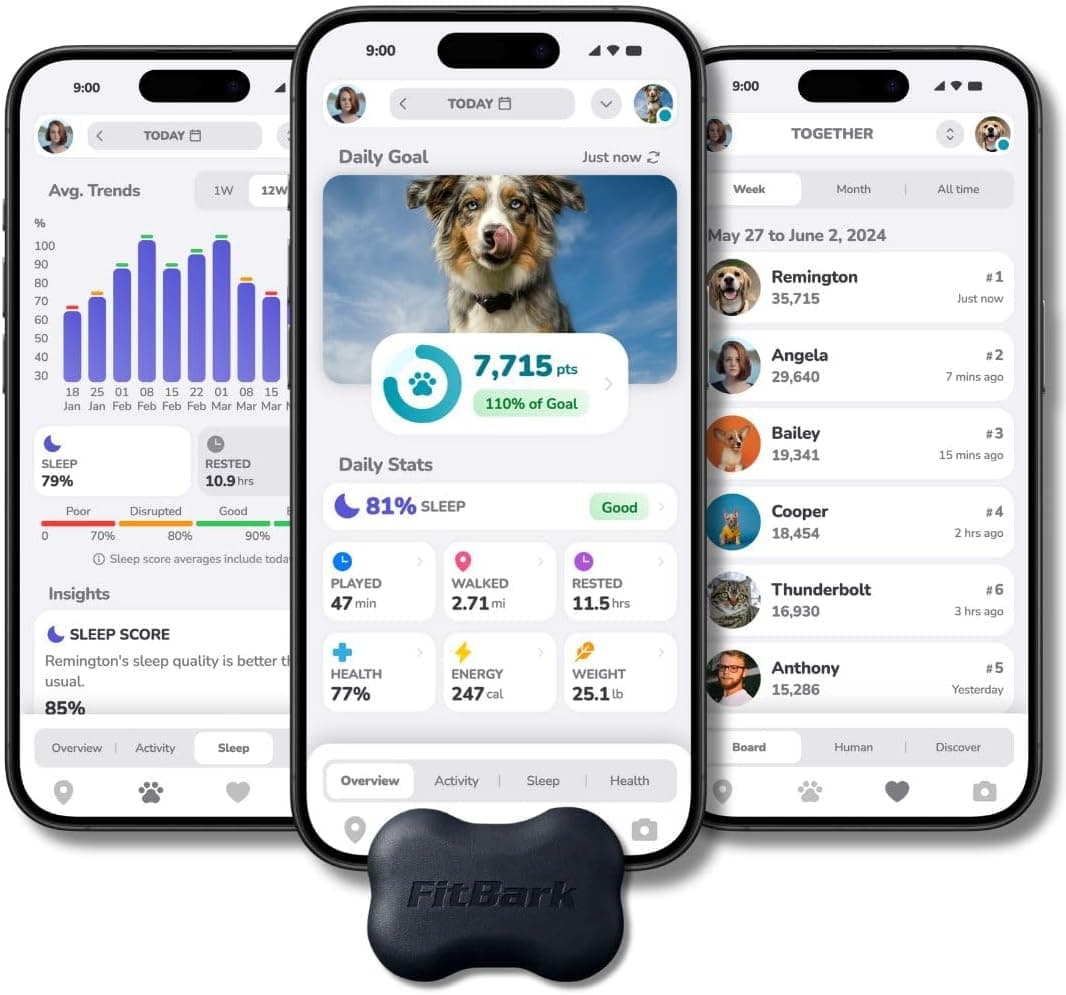
The FitBark 2 is a health and activity monitor, not a GPS tracker. It clips onto your dog's existing collar with two zip ties and uses a 3D accelerometer to measure movement intensity throughout the day. Instead of counting steps (which doesn't translate well to four-legged locomotion), FitBark uses a proprietary metric called BarkPoints that accounts for active time, play time, and rest time separately.

Each day, the app gives your dog a BarkPoints score against a breed-specific goal. You can adjust that goal up or down if your dog is recovering from injury, dealing with a health condition, or just naturally less active. The app also generates a Sleep Score (0–100) based on restlessness, waking events, and deep sleep periods — and a weekly Health Grade that compares your dog's trends to similar dogs from FitBark's user base across 150+ countries.

The device stores up to 100 days of minute-by-minute data on-board, so you don't lose information if you forget to sync for a few days. When you do open the app and sync via Bluetooth, all that stored data transfers at once.

  • Tracks: daily activity (BarkPoints), sleep quality, distance traveled, calories burned, behavioral changes
  • Alerts: unusual drops in activity or disrupted sleep patterns that may signal pain, anxiety, or illness
  • Vet sharing: generate and email PDF health reports directly from the app
  • Multi-pet: monitor multiple dogs (and cats) on a single account, each needing its own device
  • Human integration: link your Apple Health, Fitbit, or Google Fit account to compare your activity side-by-side with your dog's
  • Social: compare your dog's activity to breed averages and connect with other FitBark users (optional)

Why the Battery Life Matters More Than You Think

Most pet wearables need charging every few days to a couple weeks. That creates a real friction point — you either forget, the device goes dead and you lose data, or you're constantly plugging things in. The FitBark 2's battery lasts up to six months on a single 90-minute charge. In independent testing, one reviewer ran the device for five straight months on a Border Collie and still had 18% battery remaining.

This means you attach it once, sync it once, and then basically forget about it until the app sends a low-battery notification roughly half a year later. For busy pet parents, this is the difference between a device that gets used long-term and one that ends up in a drawer after month two.

The Zip-Tie Problem — and How to Deal With It

The single most common complaint across Amazon reviews, independent review sites, and Trustpilot is the attachment system. The FitBark 2 secures to your dog's collar with two small zip ties. For dogs that play rough at the dog park, roll in tall grass, or swim in snag-prone environments, those zip ties can break or the device can get knocked off. Multiple reviewers reported losing the device within days or weeks of attachment.

This is a real design limitation, not a minor quibble. FitBark includes replacement zip ties in the box (four total, giving you one reinstall), and you can buy additional packs for about $5. Some owners have improvised their own solutions — using heavier-duty zip ties from a hardware store, or rigging small silicone collar attachments similar to AirTag holders.

Our recommendation: attach the FitBark 2 to the side of the collar (not the bottom, where it contacts your dog's neck — some reviewers reported skin irritation from zip-tie ends rubbing). Check the attachment weekly for the first month. If your dog is a rough player, consider ordering a spare zip-tie pack upfront. The device itself is durable polycarbonate and survives chewing, swimming, and impact — it's the attachment method that's the weak link.

  • Attach to the side of the collar, not underneath, to avoid skin irritation from zip-tie ends
  • Check the attachment weekly for the first 30 days
  • Keep spare zip ties on hand (FitBark sells a pack for ~$5, or use hardware-store ties)
  • For rough-playing dogs, consider a DIY silicone sleeve or third-party collar attachment
  • The colored cover must be seated properly — if it's loose, it can fall off during play (the device still works without it, but waterproofing is compromised)

App Experience: Powerful but Not Seamless

The FitBark app (iOS 10+ and Android 5+) is feature-rich but has a learning curve. Multiple reviewers — including BBC Science Focus and independent testing sites — noted that the app isn't immediately intuitive. Settings are buried in menus, and it takes a few days of regular use to get comfortable navigating the dashboard.

A more practical frustration: the FitBark 2 syncs via Bluetooth only, with a range of about 30 feet. The app needs to be opened periodically for data to transfer. If you don't open the app for several days, you may get a 'not connected' notification and need to manually sync. This isn't a data-loss issue (the device stores 100 days on-board), but it is an annoyance — especially if you have multiple dogs and one syncs more reliably than the other.

FitBark's customer service is frequently praised as responsive and available 24/7 via in-app chat. One Amazon reviewer shared a story of a FitBark support rep personally buying an Apple AirPort Extreme to test a compatibility issue the customer was experiencing — that level of dedication is unusual in pet tech.

Real-World Use Cases Where FitBark 2 Shines

The FitBark 2 isn't a gadget for someone who just wants to see a daily step count. It's most valuable for owners dealing with specific health situations where objective data actually matters:

Arthritis and mobility management: Owners of senior dogs with arthritis use FitBark to track how much activity is too much. The data helps identify the sweet spot between keeping joints mobile and overexerting a dog in pain. One reviewer on FitBark's official site shared that the device helped them monitor activity levels for their arthritic dog and watch for pain signals.

Separation anxiety: If your dog has separation anxiety, the FitBark 2 can show you whether they're actually distressed while you're gone or just napping. A veterinary professional reviewer noted they could tell when their dog's anxiety was acting up versus when she was simply sleeping through the day.

Diabetic dogs: A reviewer managing a diabetic Jack Russell described using FitBark data multiple times daily to balance activity, food, and insulin — something they said was 'almost impossible' before the tracker.

Post-surgery recovery: After surgery or injury, vets often recommend restricted activity. FitBark gives you a concrete way to verify your dog is actually resting, not sneaking in play when you're not watching.

Skin conditions and allergies: FitBark notes that increased nighttime activity can indicate scratching from dermatitis or allergies. The sleep tracking can flag this pattern before it becomes obvious to the naked eye.

FitBark 2 vs. FitBark GPS — Which One Do You Need?

FitBark makes two devices that look similar but solve different problems. The FitBark 2 (this product) is a pure health monitor with no GPS, no subscription, and a 6-month battery. The FitBark GPS (2nd Gen) adds real-time location tracking via cellular networks but requires a subscription ($5.95–$9.95/month depending on plan length) and the battery drops to 3–5 weeks with GPS active.

If your dog is an escape risk, if you leave them off-leash in unfamiliar areas, or if you travel with your dog and worry about them getting lost, you need GPS — either the FitBark GPS or a competitor like Tractive or Fi. If your dog is safely contained and your main concern is health, activity, and sleep, the FitBark 2 is the better choice at a fraction of the long-term cost.

How it compares

FeatureFitBark 2Fi Series 3+Tractive GPS for Dogs
Price$49.95 (no subscription)$149 + $99–$186/yr subscription~$49 + $96–$300/yr subscription
Primary FocusHealth & activity monitoringGPS location + basic activityGPS location + basic activity
Subscription RequiredNo — all features freeYes — required for GPSYes — required for GPS
GPS Location TrackingNoYes (LTE-M + Wi-Fi + Bluetooth)Yes (LTE-M cellular)
Activity TrackingBarkPoints, sleep score, calories, health index, behavior alertsSteps, distance, sleep, basic behaviorSleep, barking, activity time, resting heart rate (Tractive)
Battery LifeUp to 6 monthsUp to 3 months (standard); ~2 days (Lost Dog Mode)Up to 30 days (varies by model)
Weight10g~28g (tracker module)~27g (tracker module)
Min Dog Size3 lbs10 lbs~9 lbs (Tractive DOG 4)
Waterproof RatingIP67IP68IP68
Attaches to Any CollarYes (zip ties)No — proprietary collar requiredYes (clip-on)
Vet Data SharingYes — PDF reports from appNo dedicated vet sharingNo dedicated vet sharing
Human Tracker SyncApple Health, Fitbit, Google Fit, Apple WatchApple WatchNo
2-Year Total Cost~$50~$315–$485~$145–$300
Best ForHealth-focused owners, multi-dog homes, vet collaborationEscape-prone dogs needing fast GPS alertsBudget-conscious GPS tracking with decent coverage

Free vs. subscription features

Included features

  • Full activity tracking (BarkPoints, active/rest/play time)
  • Sleep quality monitoring and Sleep Score
  • Health Index and weekly Health Grade
  • Distance traveled and calories burned
  • Behavioral change alerts
  • Vet-shareable PDF health reports
  • Multi-pet and multi-owner/caregiver support
  • Human fitness tracker integration (Apple Health, Fitbit, Google Fit)
  • Breed comparison and community features
  • On-device data storage (100 days)
  • In-app 24/7 customer support chat

Optional paid features

  • None — the FitBark 2 has no subscription tier and no paid features. All functionality is included with the one-time hardware purchase.

This is the FitBark 2's biggest competitive advantage. Every GPS-enabled competitor (Fi, Tractive, Whistle, and even FitBark's own GPS model) requires a monthly or annual subscription that adds $70–$190+ per year. The FitBark 2 is a one-time purchase with full functionality, forever. Over a 3-year ownership period, that's $50 total versus $300–$500+ for subscription-based alternatives.

What buyers tend to mention

  • Battery life genuinely delivers — multiple reviewers confirmed 6-month real-world performance, calling it 'set and forget'
  • Zip-tie attachment is the dominant complaint — device falls off during rough play, cheap ties break within weeks, risk of losing a $50+ device at the dog park
  • App sync requires effort — Bluetooth-only means the app needs to be opened regularly; some users get 'not connected' alerts every 2–3 days
  • Distance accuracy is inconsistent — several reviewers compared FitBark distance to GPS-verified routes and found it underreported, sometimes significantly
  • Sleep tracking is the surprise favorite — owners discovered restless nights correlated with health issues they hadn't noticed
  • Customer service is genuinely excellent — 24/7 in-app chat, responsive, and multiple stories of going above and beyond
  • Some Amazon inventory quality issues — a few reviewers received used or incomplete units from Amazon-fulfilled orders
  • Waterproofing improved with cover — older models had water failure; the current model with properly seated cover handles swimming reliably
  • Not a GPS tracker — a recurring theme of buyers who didn't realize the FitBark 2 has no location tracking and were disappointed

Setup tips

  1. 1. Download the FitBark app (iOS 10+ or Android 5+) before unboxing — you'll need it to pair the device
  2. 2. Charge the device fully before first use (90 minutes) — the app will confirm when it's ready
  3. 3. Attach to the SIDE of your dog's collar, not the bottom — zip-tie ends rubbing against the neck caused skin irritation for some reviewers
  4. 4. Seat the colored cover carefully — press until the edges fully wrap around the unit; a loose cover will fall off and compromise waterproofing
  5. 5. Create your dog's profile with accurate breed, age, and weight — this determines the breed-specific BarkPoints goal and comparison baseline
  6. 6. Set your activity goal based on your dog's situation — the app suggests a default, but adjust down for recovery, seniors, or health conditions
  7. 7. Open the app at least every 2–3 days for the first two weeks to establish a reliable sync rhythm — after that, the on-device storage means you won't lose data even if you forget
  8. 8. Invite your vet as a caregiver in the app if you're working on a health issue — they can view your dog's data without needing their own device
  9. 9. If you have a human fitness tracker, link it during setup — the side-by-side comparison view is one of FitBark's more motivating features
  10. 10. Order a spare zip-tie pack ($5) with your initial purchase — having extras on hand prevents a situation where the device is off the collar while you wait for replacements

Who should skip it

  • Anyone who needs GPS location tracking — the FitBark 2 has no GPS and cannot help find a lost dog. Look at FitBark GPS, Fi Series 3+, or Tractive instead
  • Owners whose primary concern is escape prevention — you need real-time alerts and live tracking, which requires a cellular subscription device
  • Dogs that play extremely rough at dog parks — the zip-tie attachment is a real risk of loss for high-activity, rough-playing dogs unless you take extra precautions
  • Anyone who wants heart rate, temperature, or respiration monitoring — the FitBark 2 doesn't measure vitals (look at PetPace or Tractive for resting heart rate)
  • Owners who want a seamless, set-and-forget app experience — the FitBark 2's app requires periodic manual syncing and has a steeper learning curve than Fi or Tractive

Questions before you buy

Does the FitBark 2 require a subscription?

No. The FitBark 2 has no subscription and no monthly fees. All activity tracking, sleep monitoring, health alerts, vet sharing, human tracker integration, and multi-pet features are included with the one-time hardware purchase. This is confirmed by FitBark's official help center and multiple independent review sources.

Does the FitBark 2 have GPS tracking?

No. The FitBark 2 is a health and activity monitor only — it has no GPS sensor and cannot locate your dog. If you need GPS location tracking or escape alerts, you need the FitBark GPS (2nd Gen), which requires a subscription, or a competitor like Fi or Tractive.

How long does the battery actually last in real-world use?

FitBark claims up to 6 months. Independent testing confirmed this is realistic — one reviewer ran the device for 5 straight months on an active Border Collie and still had 18% battery remaining. Real-world results vary based on sync frequency and activity levels, but the 6-month claim is not marketing exaggeration.

Will the zip-tie attachment hold up for a rough-playing dog?

It may not. The zip-tie attachment is the most common complaint across reviews. For dogs that play rough at dog parks, roll in dense brush, or swim in snag-prone areas, the zip ties can break or the device can be knocked off. We recommend attaching to the side of the collar, checking weekly, keeping spare ties on hand, and considering a DIY silicone sleeve for high-activity dogs.

Can I use the FitBark 2 on a cat?

Yes. FitBark officially supports cats, and the device's 10-gram weight and 3-pound minimum pet weight make it suitable for cats of most sizes. The app allows you to create a cat profile. However, the breed-specific baselines and comparison features are built around dogs, so cat data is less contextualized.

Can I share my dog's FitBark data with my veterinarian?

Yes. The FitBark app lets you generate detailed PDF health reports and email them directly to your vet from within the app. You can also invite your vet as a caregiver on your dog's profile so they can view data in real-time. FitBark is used by 100+ veterinary schools in research settings, which gives the data clinical credibility.

Does the FitBark 2 track heart rate or temperature?

No. The FitBark 2 uses a 3D accelerometer to measure movement-based activity and sleep patterns. It does not measure heart rate, body temperature, or respiration rate. If you need vitals monitoring, look at the PetPace Smart Collar or Tractive (which reports resting heart rate and respiratory rate).

What happens if I don't open the app for several days?

The FitBark 2 stores up to 100 days of minute-by-minute data on the device itself, so you won't lose information. When you next open the app and the device is within Bluetooth range (~30 feet), all stored data will sync at once. However, some users report occasional 'not connected' notifications that require manual syncing, which can be frustrating.

Is the FitBark 2 waterproof enough for swimming?

Yes, with the cover properly seated. The FitBark 2 has an IP67 rating, meaning it can be submerged in up to 1 meter of water for 30 minutes. The colored cover must be fully seated for waterproofing to function. Some early models without covers had water failure issues — the current model with cover handles swimming reliably according to updated reviews.

What's the difference between buying on Amazon vs. directly from FitBark?

Buying from FitBark directly includes a 2-year warranty, free shipping, and a 30-day money-back guarantee. Buying on Amazon may have a shorter warranty period (1-year limited) and some reviewers reported receiving used or incomplete units from Amazon-fulfilled inventory. If warranty length and guaranteed-new condition matter to you, buying direct is the safer route. If price and Prime shipping are your priority, Amazon is currently offering it at $49.95 (vs. $39.95–$69.95 on FitBark's site, which varies by sale).

Start Tracking Your Dog's Health — No Subscription Required

The FitBark 2 occupies a specific and important niche: it's the only mainstream dog health monitor that charges once, costs nothing ongoing, and gives you research-grade data your vet can actually use. For owners focused on activity, sleep, and behavioral trends — whether for a healthy dog they want to keep that way, or a dog with a health condition they're actively managing — it delivers more value per dollar than any subscription-based competitor. The 6-month battery and 10-gram weight remove the two biggest friction points that kill long-term use of pet wearables. The trade-offs are real and worth understanding before you buy. There's no GPS, so this device plays no role in finding a lost dog. The zip-tie attachment is a genuine design weakness that has cost owners their devices — you need to take attachment seriously, check it regularly, and probably buy spare ties. The app isn't seamless and requires periodic manual syncing. And distance accuracy isn't precise enough to rely on for exact mileage — it's better understood as a relative activity gauge than a precise measurement tool. If you want GPS, buy the FitBark GPS (2nd Gen), Fi Series 3+, or Tractive — all of which require subscriptions but solve a fundamentally different problem. If you want health data without a monthly bill, the FitBark 2 at $49.95 is the clear category leader and the one we'd recommend first. At that price, the 3-year total cost of ownership is less than what Fi charges for a single year of subscription alone.

The FitBark 2 is currently $49.95 on Amazon (down from $69.95 list). At that price with no monthly fees, it's one of the lowest total-cost-of-ownership devices in all of pet tech. If you've been waiting for a dog health monitor that won't add a recurring line item to your budget, this is it.

Check today's Amazon price